Tuesday, 28 October 2025 at 1:17 am
Studying
This email was originally sent to my tutoring students on 28/10/2025.
Hello Students (cc Parents),
I wanted to put into writing some tips I have for preparing for the coming exam season. These tips, while centered around maths, will likely transfer to all of your subjects.
There are three things I want you to remember:
Make a plan
Training specificity
Execute (and then stop)
1 - Make a plan
Students often express apprehensions like: “Exams make me feel stressed”, “I don’t know where to start”, “What do I do?“. To these students, I always say: Make a study plan. The basics of a study plan always include:
- Listing out all the tasks that need to be done. Whether that’s weeks of content, chapters, practice exams, etc., it doesn’t really matter. What matters is that you have a list of all tasks broken down into small chunks.
- Listing out all the days between now and the exam. I like to also put down how much time I have on each day to spend studying, and which days I am going to take a break.
- Assign the tasks to days. I often use a spreadsheet for this, but it doesn’t really matter. Make sure you leave a bit of space in case some things don’t get done on their specified days.
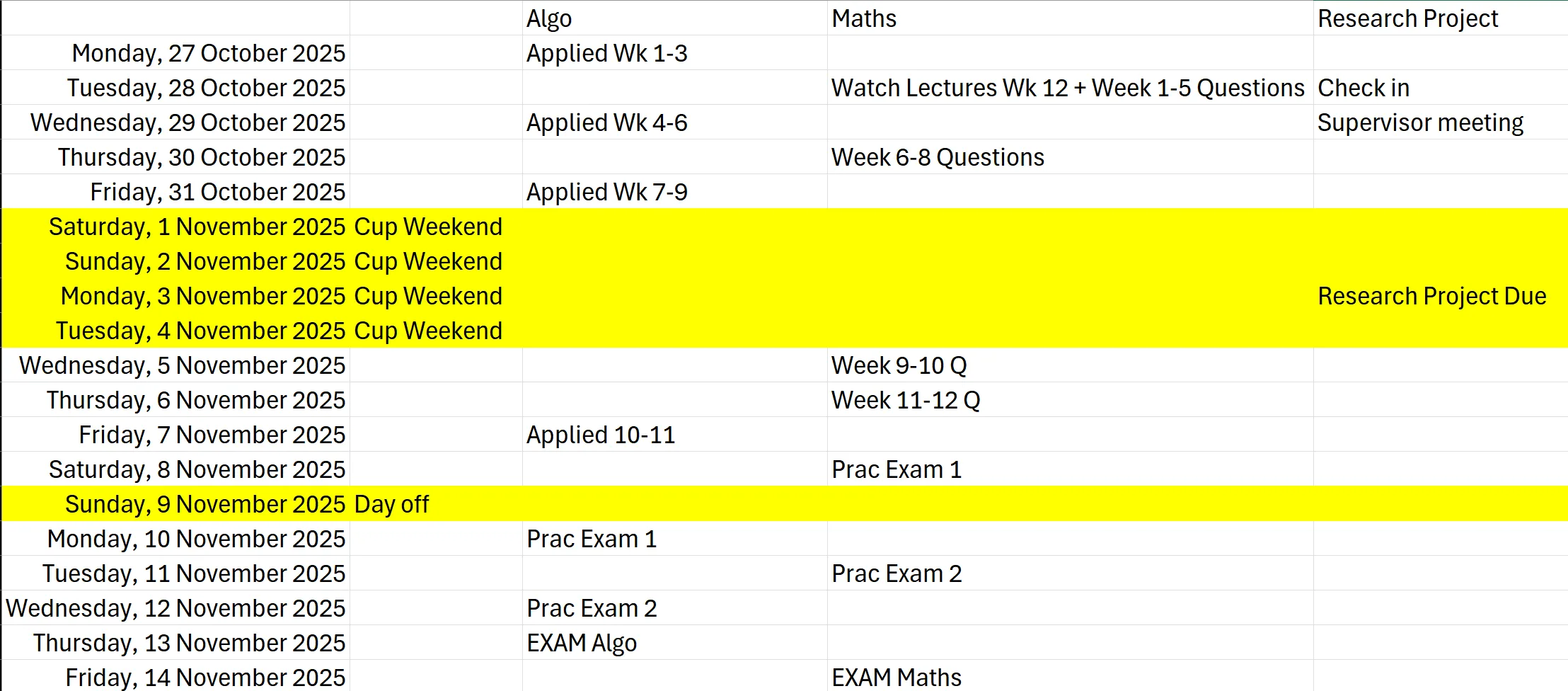 Here is my study plan for the coming period. Unfortunately, at Uni we get few practice exams, so we have to spend more time reviewing content instead.
 2 - Training specificity
Once you have the plan, it can be tempting to think that each individual task is not super important, that they can be approached casually, but I would advise against it.
To explain this, I have borrowed a term from exercise physiology, “training specificity”. In physiology, it is the principle that the training should match the event being trained for as closely as possible.
For example, if you wanted to run 10km as quickly as possible, then the principle would tell us that running 10km is better training than running intervals, which is better training than riding a stationary bike.
In the context of exams: How similar is your training (study) to the real thing? If the answer is not much; perhaps you don’t time your exams, or you check your phone occasionally, or you do it in chunks because the length of the exam is annoying to do in one sitting, or you only do individual practice questions and not exams*, then your training specificity is low. If that’s you, there is real value in trying to increase it.
Try and make the way you practice mirror the real thing, because when the real thing That means:
- Find a quiet place where you can do the whole exam uninterrupted
- Leave your phone somewhere else
- If it’s tech-free, then also leave your notes and CAS
- If it’s tech-active, then make sure to have them
- Time the exam, and use the full time even if you feel done
- Time and use your reading time. I know it is boring, but when you get to the exam and don’t feel like you wasted the first 15 minutes, you’ll thank me.
- Mark it in full, and mark it as harshly as you think your teacher would (if you don’t feel like you can do that, you can ask your teacher or me to mark the exam)
* A note on practice questions: I have no problem with them, but too often they are used as a crutch by people who are trying to avoid doing practice exams.
3 - Execute (and then stop)
Many students are under the impression that more study is better, but I can tell you from experience that is not always true. The student who spends 2.5 hours doing one practice exam really well is much better off than the student who spends 4 hours meandering through a set of practice questions. Go at 100% for a short period and then be done. Even in SWOT Vac, 3 hours per day borders on excessive. (Make sure to factor this into your study plan).
If you get what’s done on your study plan earlier than expected, stop. Don’t fall into the trap of being done a bit earlier and then trying to squeeze more in. The problem is that what always ends up happening is that people work themselves until they get over-tired, and then the next day they have less mojo to keep going.
I also want to talk about rest in general. During intense study times like SWOT Vac, I recommend taking 1 day per week off entirely and for anything longer than 2 weeks, having some longer break (2 or 3 days) in the middle. Also in the category of rest is sleep. I can’t stress how important sleep is. The science is in: sleep makes the difference. (Want the science firsthand: read ‘Why We Sleep’ by Matthew Walker) I know from experience how hard it is to choose sleep when everything cool seems to be going on, so here are some of my most effective strategies to help:
- Leave the phone somewhere else while you sleep. Ideally outside your room, but I know that doesn’t work for most, so if not that, then at least out of reach from the bed like on the other side of the room. If you can manage that, then try never taking it to the bed to begin with.
- No scrolling (i.e. vertical videos, social media, and news). This was an initiative started by a friend and me after we realised that we were not really getting a fair deal in our use of social media. If that doesn’t work, try no scrolling after dinner or before breakfast. Then you still get to keep up with what’s going on, while not effecting your sleep too much. (Want the science: read ‘The Anxious Generation’ by Jonathan Haidt)
- Set a sleep alarm. Surprisingly effective. I have an alarm set for 10pm, and it’s great because by the third snooze I am thinking, “it must be quite late, that thing has been bugging me for ages” and it’s not even 10:30pm.
That’s all from me; I hope this has helped. Let me know if you have any questions. Otherwise, good luck with your exams and I’ll see you at our regular sessions.
Gabriel